
What Makes a Product Feel Like Your Brand?

Creating Product DNA That Customers Remember
Building your brand through your product may sound obvious, though it isn't always clear to apparel founders.
It's easy to think the product is secondary to marketing, social media, and storytelling. I've met founders who believed they had already built the product because they had built the brand story they were ready to tell.
The challenge is that a story alone is rarely enough.
In reality, no successful product brand has achieved meaningful growth because of a great tagline. The tagline only exists because there is a product worth talking about in the first place.
Words are only words. The tangible thing you're creating and the reason it needs to exist are what matter. A mission can attract attention, but it only creates loyalty when the product delivers on that promise.
That's why marketing and product development aren't separate conversations. Marketing amplifies Product DNA. It doesn't create it.
We've touched on pieces of this through concept development, color strategy, and print. But the strongest brands understand something larger: the product itself becomes the brand language.
In many ways, this article is the culmination of the concepts we've discussed throughout this series. Concept, color, print, materials, fit, and function are not separate conversations. Together, they become Product DNA.
The Brands You Recognize Without a Logo
Some brands become recognizable through a single signature. Others through a combination of elements working together.
As I discussed in my recent article on print, Farm Rio is a great example. Their use of print and color has become part of the brand itself. Before you see a logo, you often know exactly whose product you're looking at.
With Varley, it's often the fabric story. With Eberjey, it's the combination of palette, silhouette, and softness.
The strongest brands don't rely on logos to communicate who they are.
The product does it for them.
Product DNA Starts With Product Pillars
The moment you move an idea from your head into a product, you begin building your brand.
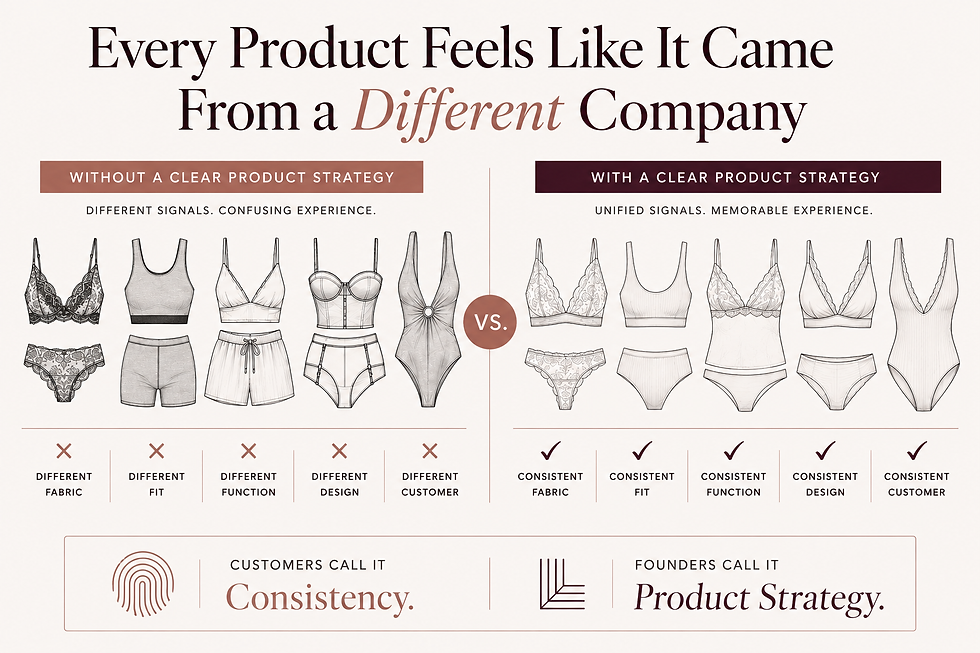
Every successful product brand starts with a clear set of product pillars. These are the four to six characteristics that define your brand and guide every product decision you make.
Think of them as the recipe for your uniqueness.
For founders just launching, these pillars become your roadmap. Your customer hasn't spoken yet, so your pillars become the filter through which every decision is made.
Every product should support them.
Every design decision should reinforce them.
Decide What Never Changes
One of the biggest mistakes founders make is focusing entirely on what will be new.
Strong brands know what will stay the same.
These are the product decisions your customer would revolt over if you removed them.
For a full-bust swim brand, it might be support technology.
For a comfort-driven brand, it might be fabric softness and the innovation it took to get you there.
For a performance brand, it might be durability and function.
These repeated signals become the things customers learn to trust.

Product DNA in Practice
Consider Lingua Franca.
The brand is built on a unique combination of personalization, social responsibility, wit, and simplicity. It knows exactly who its customer is and what resonates with them.
Their sweaters aren't simply about embroidered sayings. The embroidery is only one part of a much larger product story.
The embroidery gets attention.
The product earns loyalty from exactly the people the brand set out to serve.
Then those customers carry the message further than any tagline ever could..
When Marketing Outpaces Product
As I discussed in a previous article, Parade is one example that stands out to me.
The messaging was compelling. The mission was clear.
But eventually, there wasn't enough product substance to support the conversation.
Customers may initially be drawn in by a story, but they stay because the product delivers.
Compare that to Mott & Bow, where customers consistently talk about the product itself. I am now a diehard because one of my friends who has great style told me about them.
The best brands create product advocates, not just brand awareness.
Materials, Design, and Function Work Together
If product pillars are the strategy, materials are often the first proof point.
Think about brands like Varley, Alo, and Skims. Their fabrics aren't accidental. They are carefully selected to support performance, comfort, durability, and aesthetic goals.
Customers don't rave about your sourcing process.
They rave about outcomes.
"It's the softest pant I've ever worn."
"It still looks new after a season."
"It finally fits me as a 40DD."
The reviews become the marketing.
Design works the same way.
Whether you're creating a better sports bra, a more comfortable swimsuit, or a more functional piece of loungewear, every design should support multiple product pillars at once.
Function is often where Product DNA becomes most tangible.
Support.
Adjustability.
Comfort.
Ease of wear.
The best products make life easier while still feeling intentional and beautiful.
Color Reinforces Recognition
We've already discussed color extensively in previous articles, but it deserves a brief mention here because it plays a role in brand recognition.
Over time, customers begin to associate specific palettes and color attitudes with your brand. Those choices become signatures.
Color is not decoration.
It's another way your product communicates who you are.
A Simple Product DNA Test
Ask yourself:
What are the four to six product pillars that define my brand?
What would customers miss if I removed it?
What details appear repeatedly across my collection?
Could someone recognize my product without seeing the logo?
If those answers aren't clear, your Product DNA probably isn't either.
The Product Comes First
The logo matters.
The photography matters.
The website matters.
They all help tell the story.
But they are not the story.
The product is.
When materials, fit, function, design, color, and purpose consistently reinforce one another, customers begin to recognize your brand long before they see your logo.
And once that happens, marketing becomes much easier.
Because there is finally something worth talking about.
If you're building an apparel brand and want to make sure your print strategy is working for your brand, not against it, that's exactly the kind of clarity we work through together. Book a call here to talk through where you are and what your product actually needs.


Comments