
From Fittings to Better Product: How to Write Fit Comments That Get Better Results
Updated: Jul 23

Part Two in My Garment Fitting Series
In my last article, I shared five habits that help founders get more out of every fitting. We talked about preparing before the sample ever goes on the body, protecting the design intent, and approaching a fitting with enough structure to make thoughtful decisions instead of emotional ones.
This article begins where that one ends.
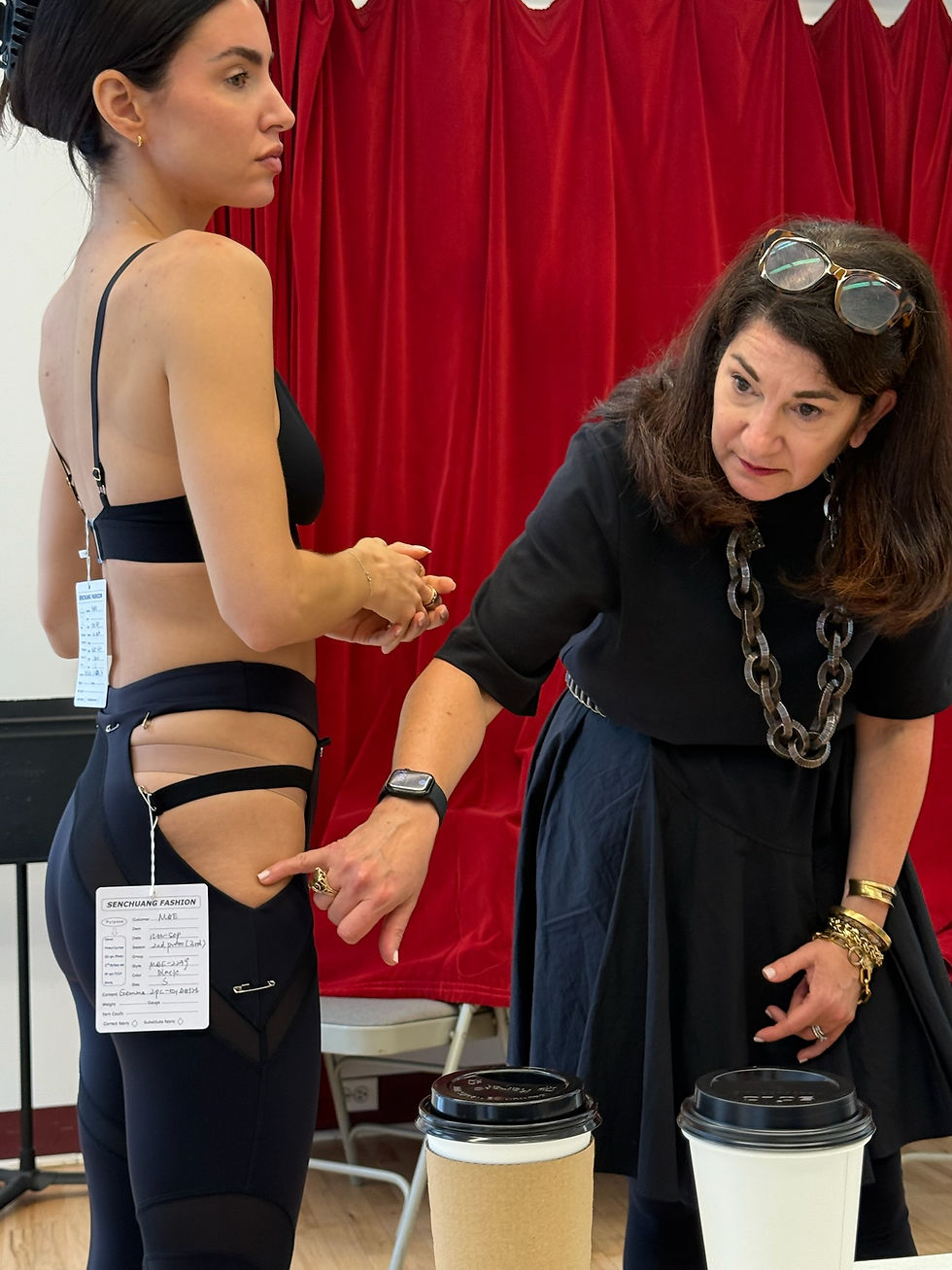
Once a fitting is over, every observation, photograph, pin, and discussion has to be translated into clear direction for the factory. Those fit comments become the roadmap for the next prototype. When they're thoughtful and organized, development moves forward. When they're vague or reactive, the next sample often raises as many questions as it answers.
This is one of the least talked about skills in product development.
Founders spend months creating concepts, selecting fabrics, and refining details before their first prototype arrives. Then, when it finally does, all of that work can be helped—or hurt—by the quality of the decisions made during one fitting.
The good news is that better fittings are a learned skill.
Whether you're working with a technical designer, an in-house development team, or navigating the process yourself, the goal is the same: observe carefully, think critically, and communicate clearly.
.
Before the Fitting
Form your own point of view
The fitting starts long before the garment goes on the body.
When a new sample arrives, give yourself a few quiet minutes with it before everyone begins sharing opinions. If you need thirty seconds to celebrate seeing your idea become a real garment, take it. It's a great moment. Then shift into evaluation mode.
Lay the garment on the table.
Customers do exactly the same thing. Before they ever try something on, they look at it. They notice proportion, balance, stitching, color, details, and quality. Your first impression matters too.
Study the garment without trying to solve anything yet.
Look for balance. Does anything immediately feel oversized or unusually small? Is there twisting, unexpected fullness, or distortion? Turn the garment over. Look inside. Construction often explains what you'll later see on the outside.
The goal isn't to make decisions. The goal is to gather information.
Measurements are evidence
There are different schools of thought about measuring a prototype before the fitting. Sometimes I measure first. Sometimes I wait. It depends on the garment, the vendor and what I'm seeing.
One principle rarely changes.
Measurements are evidence. They're not conclusions.
A garment can measure perfectly and still fit poorly. Another can be slightly outside spec and perform beautifully once it's on the body. Use measurements to support your observations, not replace them.
Keep the design intent close
Before discussing changes, remind yourself what the garment was designed to accomplish.
Support. Coverage. Comfort. Freedom of movement. A particular silhouette.
That purpose should become the filter for every decision that follows.
Without it, fittings can quickly become a collection of personal opinions instead of thoughtful product decisions.

During the Fitting
Observe before you solve
One of the easiest traps is trying to fix the first thing you notice.
Slow down.
Walk around the wearer. Look from every angle. Watch the garment standing still before asking for movement.
The first answer isn't always the right answer.
Think like a detective before you think like a mechanic. Collect the clues before reaching for the tools.
Listen for the problem
Whenever possible, wear your own product. There is no substitute for experiencing it yourself.
Whether the wearer is you, a fit model, or a customer tester, pay close attention to what they feel. They know where something rubs, shifts, gaps, or feels restrictive.
Those comments are incredibly valuable.
Just remember that they're describing a symptom.
Your job is to understand the cause.
A neckline that feels too high may actually be a balance issue. A slipping strap may have little to do with the strap itself.
Good fittings are rarely about quick answers. They're about asking better questions.
Separate priorities from preferences
Not every observation deserves a correction.
Some issues are critical.
Some can wait.
Some are simply preferences.
One of the most valuable skills you can develop is learning the difference.
Before the fitting ends, recap the decisions with everyone involved.
Confirm what is changing, what is staying the same and what you'd like to evaluate again on the next sample. That five-minute conversation creates alignment before anyone begins writing fit comments.
After the Fitting
Turn observations into action
Write comments while the fitting is still fresh.
Organize them by area of the garment instead of the order they happened. Explain not only what should change, but why.
Remember that fit comments are a partnership. Strategic product decisions, technical design, and factory execution each play a different role. The clearer the thinking behind the comments, the easier they are to execute.
Let photos support the story
Photographs are one of your best communication tools, but they shouldn't replace written comments.
Capture what is working as well as what isn't.
Label images clearly.
Don't forget to photograph the inside of the garment when it's helpful.
Sometimes the internal support, seam placement or construction tells the story far better than the outside view alone.

One final question
Before sending comments to the factory, ask yourself one last question.
Does every requested change move the garment closer to what it was designed to do?
If the answer is yes, send it.
If not, take another look.
Final thoughts
A successful fitting isn't measured by how many comments you generate.
It's measured by the quality of the decisions that follow.
Every sample is trying to teach you something. The challenge isn't simply finding what's wrong. It's learning to separate observations from assumptions, symptoms from causes, and preferences from priorities.
Do that consistently and every prototype becomes a little smarter than the last.
And that's how great products are built.
If you're building an apparel brand and want to make sure your development strategy is working for your brand, not against it, that's exactly the kind of clarity we work through together. Book a call here to talk through where you are and what your product actually needs.


Comments